
After years of diplomatic friction that nearly severed one of Asia’s most strategically important bilateral relationships, India and Canada are now advancing formal negotiations toward a Comprehensive Economic Partnership Agreement, with a hard deadline of year-end 2026 and an ambitious trade target of USD 50 billion by 2030.
The momentum is real. As India’s former High Commissioner to Canada, Sanjay Kumar Verma, noted in analysis published on 21 April 2026, the relaunch of talks during Canadian Prime Minister Mark Carney’s visit to New Delhi in March this year has provided a second chance to build a durable bilateral economic relationship amid a changed geopolitical landscape.
A Diplomatic Reset with Commercial Stakes
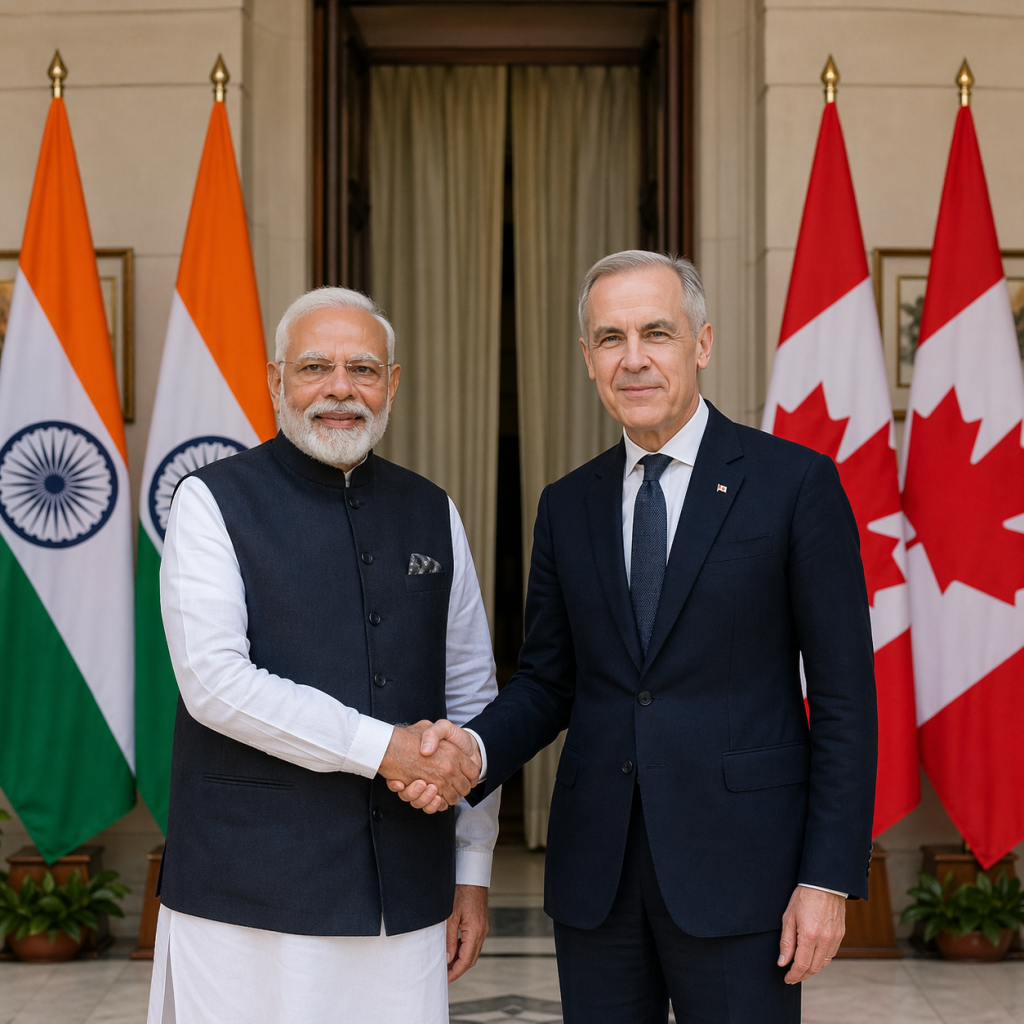
The Terms of Reference for the India–Canada CEPA were signed on 2 March 2026 by India’s Minister of Commerce and Industry, Piyush Goyal, and Canada’s Minister of International Trade, Maninder Sidhu, in the presence of Prime Ministers Narendra Modi and Mark Carney at Hyderabad House, New Delhi. The ceremony marked the formal end of a diplomatic freeze that had begun in 2023, triggered by a politically charged dispute over the killing of a Canadian Sikh activist.
Carney’s visit, his first to India since assuming office, and the first bilateral visit by a Canadian Prime Minister in eight years, has been described by Indian officials as an important inflection point, shifting the relationship from episodic transactions toward a strategy of deep economic integration.
The numbers underscore how much room for growth exists. Bilateral trade stood at USD 8.66 billion in FY2024–25, a figure that both governments acknowledge falls well short of the relationship’s potential. Reaching USD 50 billion by 2030 would require more than a fivefold expansion, achievable only through structural reform, tariff liberalisation, and the removal of regulatory barriers that have long constrained commercial flows.
What the Agreement Covers
The proposed CEPA is expected to cover trade in goods and services, investment flows, and regulatory cooperation. Edunovations Negotiating teams are expected to address market access for pharmaceuticals, iron and steel, textiles, and electronics on the Indian side, alongside Canadian exports of pulses, coal, fertilisers, and crude oil.
Beyond goods, services trade, already a strong pillar of the relationship, can deepen significantly, particularly in information technology, education, and professional services.
The agreement also carries a critical minerals dimension. Key areas of cooperation include clean energy, critical minerals, agricultural value chains, advanced manufacturing, and technology cooperation. A separately signed uranium supply agreement between Canada’s Cameco Corporation and India’s Department of Atomic Energy, valued at CAD 2.6 billion, signals that the energy component of this partnership has already moved from negotiation to execution.
Canada’s Strategic Calculus
The timing of Canada’s renewed engagement with India is not accidental. Former High Commissioner Verma pointed directly to Canada’s structural dilemma: its overwhelming economic dependence on the United States has become a strategic constraint, particularly in an era of geopolitical uncertainty. Diversification is no longer optional. In that context, India represents not just another market, but a long-term strategic partner.
With the second Trump administration reshaping the terms of North American trade, Ottawa has strong incentive to accelerate partnerships that reduce reliance on a single market. India, the world’s fourth-largest economy by purchasing power parity, offers precisely that.
Institutional Architecture to Protect the Deal
A recurring risk in India–Canada economic engagement has been the intrusion of political friction into commercial channels. Both governments appear determined to insulate this round of negotiations from that pattern. Several high-level platforms have been launched or revived, including the India–Canada CEO Forum, which reconvened in New Delhi on 2 March 2026, bringing together senior business leaders to identify actionable investment opportunities.
Verma has argued that the answer to preventing political disruption does not lie in assuming such episodes will not recur, it lies in designing institutions that ensure they do not derail economic engagement. A staged negotiating approach has been proposed: consolidating earlier progress under the Early Progress Trade Agreement framework first, then incorporating more complex areas such as investment protection, digital trade, and intellectual property in subsequent rounds.
The First Formal Round
The first round of India–Canada CEPA negotiations is scheduled for April or May 2026, following preparatory virtual talks. Bilaterals The negotiating framework gives both sides a clear procedural roadmap, defining format, frequency, and approach, with the overarching directive to conclude an ambitious, balanced, and commercially meaningful agreement before the end of the year.
For businesses operating across technology, financial services, agriculture, energy, and manufacturing, the CEPA process now represents one of the most consequential bilateral trade negotiations currently underway in the Indo-Pacific corridor. The capital implications, particularly for Canadian pension funds already committed to Indian infrastructure and renewable energy, and for Indian technology firms with a growing footprint in Canada’s services economy, are significant and accelerating.