
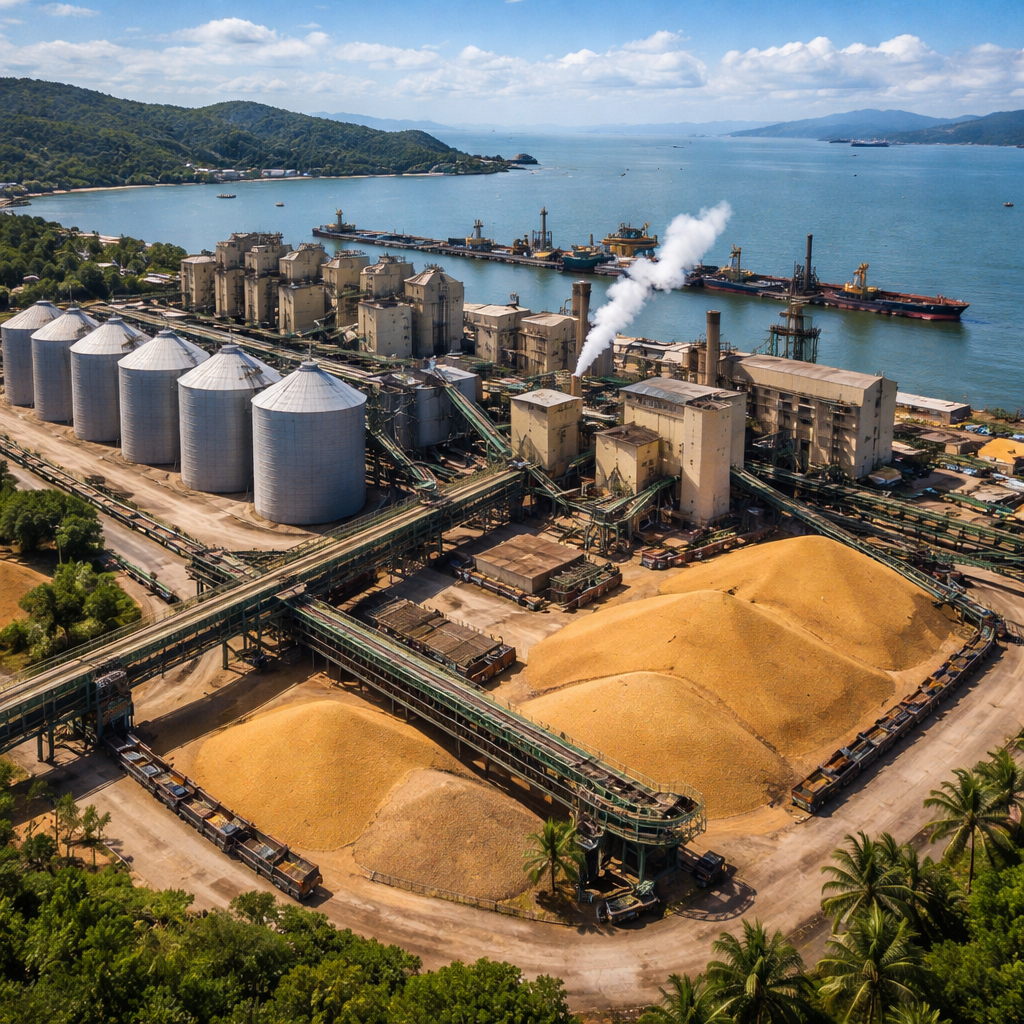

China’s state-backed agribusiness giant COFCO has announced a $1.2 billion investment to expand soybean crushing and export infrastructure across Brazil, adding 5 million tonnes of annual processing capacity in key agricultural states including Mato Grosso and Paraná.
The expansion, disclosed this week as part of COFCO’s 2026 Latin America growth strategy, marks one of the largest single capital deployments into Brazil’s oilseed processing sector in the past 12 months. Construction is scheduled to begin in the second quarter of 2026, with phased commissioning expected through 2027.
The move strengthens China’s long-term food security positioning while deepening Brazil’s role as the world’s dominant soybean supplier.
Scaling Processing, Not Just Exports
Brazil is already the world’s largest soybean producer, but much of its export profile remains focused on raw bean shipments. COFCO’s investment shifts the value chain toward domestic crushing — converting soybeans into meal for livestock feed and oil for food and biofuel markets before export.
“Processing capacity is where margin and supply-chain control converge,” industry analysts note. By expanding crushing facilities inside Brazil, COFCO gains:
• Greater control over protein feed flows into Asian livestock markets
• Higher-value export streams compared to raw commodity shipments
• Reduced exposure to logistics bottlenecks during peak harvest season
The additional 5 million tonnes of annual crushing capacity represents roughly 3–4% of Brazil’s current installed processing base — a meaningful increment in a market defined by scale.
Logistics and Port Integration
A significant portion of the $1.2 billion allocation is earmarked for port terminal upgrades and storage infrastructure near Paranaguá and northern export corridors.
Brazil’s soybean logistics network has long been strained during harvest months. By integrating inland processing with export terminals, COFCO reduces transport duplication — moving processed meal and oil directly to vessels rather than shipping raw beans long distances.
Cold-chain and storage modernization are also included in the investment package, reducing post-harvest losses and improving quality control for premium buyers.
Strategic Implications for Global Food Trade
The timing is not accidental. China continues to diversify agricultural sourcing amid geopolitical uncertainty and supply volatility.
Brazil now accounts for more than half of China’s soybean imports, and deeper infrastructure ownership gives Chinese buyers greater insulation from global commodity shocks.
For Brazil, the investment reinforces its transformation from primary producer to industrial-scale agro-processor. Local construction activity, rural employment, and export earnings all stand to benefit from expanded domestic value addition.
Capital Flows into Food Infrastructure Accelerate
The COFCO announcement signals a broader trend: global food security is increasingly being addressed through direct ownership of processing and logistics assets rather than spot-market purchasing.
Institutional capital is moving beyond farmland acquisition into:
• Crushing facilities
• Grain terminals
• Inland rail and barge logistics
• Storage and handling modernization
Food infrastructure is becoming a strategic asset class.
Why This Matters Now
Soybeans sit at the center of the global protein economy — feeding poultry, pork, aquaculture, and increasingly supporting biofuel production.
By committing $1.2 billion into Brazilian processing capacity this week, COFCO is not merely expanding production. It is securing supply chains, upgrading infrastructure, and embedding itself deeper into the most important agricultural corridor in the world.
The investment underscores a simple reality: in 2026, food security is industrial policy.


